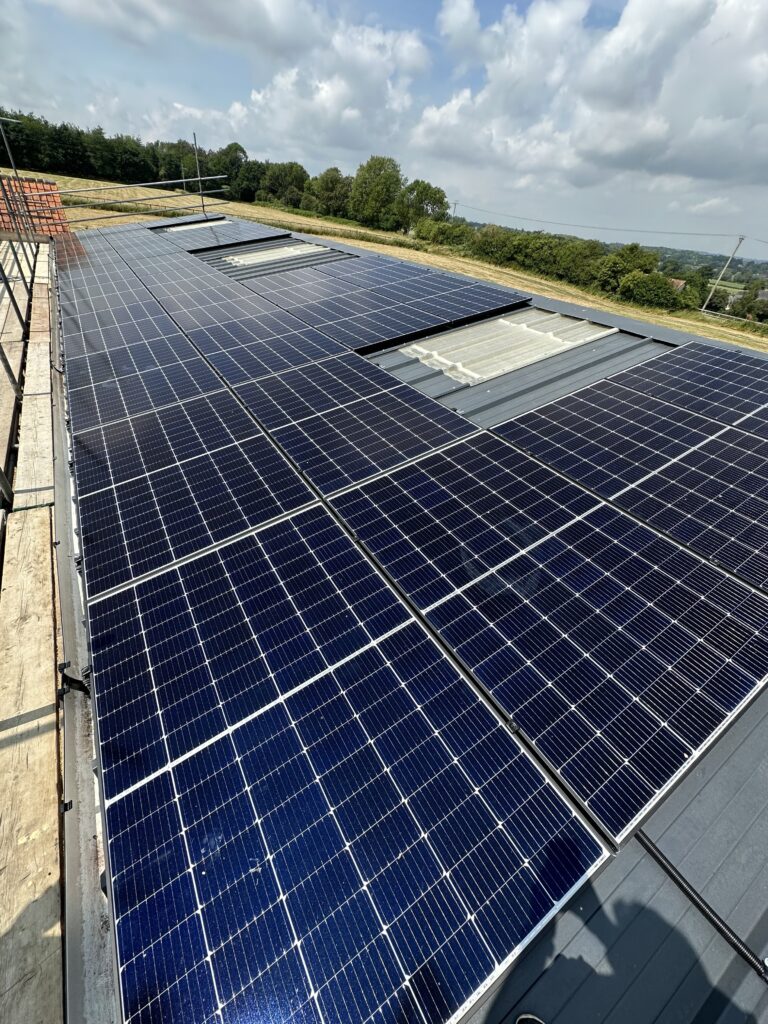
The answer is yes. If you have been asking yourself whether or not you can put solar panels on a flat roof, it is a resounding yes. Our engineers can install PV panels on flat roofs which work very well. Whether it be on your extension, garage or even commercial units across Brighton to Chichester. Reality is, that most flat roofs are not truly level anyway as they will often have a gentle fall of 1–10 degrees so that rain water runs off. It is worth noting that people often search for flat panel solar panels but they are all flat!
How flat roof PV panels are fixed
There are 2 main ways to secure the PV panels on the flat roof. These consist of ballasted frames that sit on the surface and are held down with weighted blocks so that nothing will go through the waterproofing of the actual roof. Then you have the bolted/penetrating systems that fix the structure in place and saves weight but means that each fixing point then needs to be properly sealed.
The layout matters, ideally wanting south facing rows tilted at 10–15 degrees as these tend to give out the best output per panel. East West layouts place panels back to back in low rows which fits more panels on the same roof and catches less wind.
Wind is a big factor on the South Coast, so we will always take this into consideration when working out the best way to secure the solar panels. We take into consideration the following things:
- Roof height
- Exposure and distance from the edges
The solar solutions that a flat roof needs are genuinely different from pitched roof work. All surveyors should be able to explain which system they recommend and why.
When the roof itself is the question
We will always have an honest conversation about the state of the roof as some cases will include older timber decks, insulation boards that don’t take much weight and tired felt nearing end of life. This all needs to be carefully thought out before installing them as in some cases repairs to the roof may be required. Options tend to include:
- lighter rail systems that cut the added weight
- load spreading boards or mats that share the weight across more of the deck
- a structural engineer’s sign off before any work starts
- a ground mount in the garden instead, if the roof simply is not suitable
A proper survey should measure the roof and its falls, identify how the deck is built, check joist sizes and spans where possible, assess the membrane, note parapets and drainage outlets, and photograph all of it.
Can you put solar panels on a flat roof without harming the covering?
In most cases, yes, providing the system suits the covering. Felt, EPDM, GRP and single ply membranes all behave differently under a PV panel roof installation. Some membranes will react to certain rubbers and plastics so the protective pads and mounting feet must be compatible. Every frame should sit on some form of protective layer so it doesn’t puncture or rub the surface.
Drainage outlets must remain clear and we will always leave access walkways so the roof can be maintained and inspected. If the roof is brand new, we would usually check with your roofer as we would not want to void any new roof warranty.
Output and upkeep
Solar panels UK flat roof yields hold up well when considering the tilt and orientation has been optimised. These typically produce close to those on a pitched roof and the East West layout can make up the difference with more panels fitted.
There are things that need to be managed on flat roofs. Due to the low tilt, rain does not clean the panels effectively so can be left with a build up of dirt along the bottom edge. So we would recommend cleaning these to keep the output up. Rows must also be spaced so they do not provide shade to each other.
Flat solar panels give you the freedom to face the panels where they perform best / get the most sunlight, rather than following the direction of your roof. Access and servicing these is often a lot safer and easier than a steep pitched roof.
Rules, cost drivers and next steps
On houses in England, flat roof solar is usually permitted development if the highest part of the system is no more than 0.6 metres above the highest part of the roof (excluding any chimney) and panels are set back at least 1 metre from the roof edge. Commercial buildings can usually go up to 1 metre.
If you are getting these fitted in a conservation area then you will need to ask the council whether approval is required before installation. If you have a flat, leasehold property or home with restricted development rights then you should always check with your planners first. Building regulations also apply which is where the structural check comes in.
What moves the price up or down:
- access, scaffolding and roof height
- ballast versus fixed mounting
- any structural or membrane work
- the number of panels and inverter choice
- adding a battery or EV charger
The process ties together neatly. We carry out a free flat roof survey, design the system and calculate the loads, and we are proud to announce that we are MCS certified installers. This is needed for the Smart Export Guarantee. We also handle the DNO application with your network operator.
Before signing with any installer, including us, ask:
- How have you calculated the ballast or fixings for my roof?
- Will this affect my roof warranty?
- Who checks the structure, and will I get that in writing?
- Are your engineers in house or subcontracted?
- Who handles the DNO application and MCS paperwork?