One of the first questions homeowners ask is:
“Can I install solar panels on my roof?”
The good news is most homes can.
Over the last 15 years, Bright Spark Energy has designed and installed hundreds of solar PV systems across Sussex, Hampshire, Surrey, Kent and the South East, on everything from Victorian terraces and listed buildings to new-build homes, farm buildings and luxury country estates.
Many homeowners assume their roof isn’t suitable because:
- It faces east or west
- There are nearby trees
- It’s an older roof
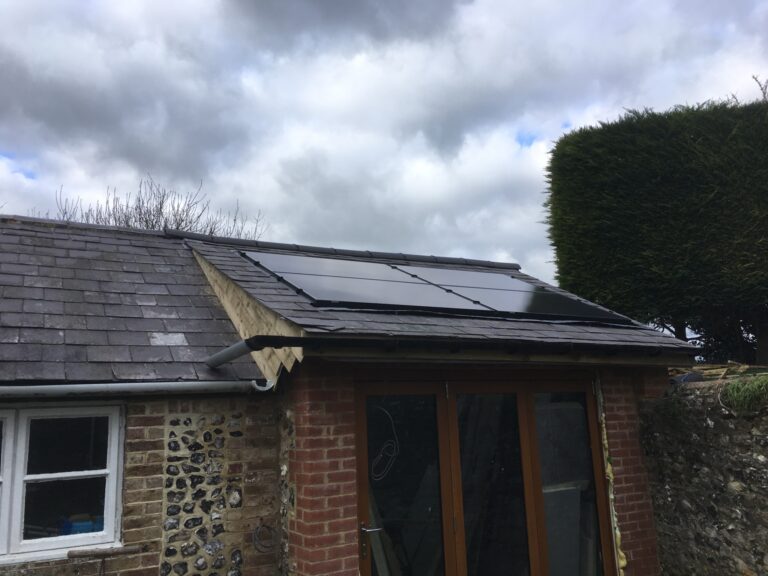
- It’s covered in slate
- It has several roof faces
- It’s a listed building
Thanks to modern solar technology, these are rarely reasons not to install solar.
Instead, they’re design considerations that experienced installers know how to overcome.
1. Roof direction – south isn’t everything
Years ago, every installer wanted a roof facing due south.
While south-facing roofs still produce excellent annual generation, modern systems perform exceptionally well on many other orientations.
Excellent results can be achieved on:
- South
- South East
- South West
- East
- West
In fact, east and west-facing systems often produce electricity over a much longer period throughout the day.
Instead of generating everything around lunchtime, they continue producing during the morning and afternoon when many families actually use electricity.
This often means:
- Higher self-consumption
- Better battery charging
- Lower electricity bills
- Less energy exported back to the grid
For many households, particularly those working from home, east/west systems can actually provide better financial returns than a purely south-facing array.
What about north-facing roofs?
North-facing roofs were traditionally avoided.
However, with today’s high-efficiency solar panels and battery storage systems, they may still be worth considering where:
- Electricity prices are high
- Roof space is limited
- Batteries are installed
- Premium high-output panels are used
Every property should be individually modelled rather than relying on generic rules.
2. Roof pitch
Solar panels perform best on roofs between 30° and 40°.
Fortunately, they continue to work extremely well over a much wider range.
| Roof pitch | Suitability |
|---|---|
| Flat roof | Excellent |
| 15°–25° | Very good |
| 30°–40° | Excellent |
| 45°–60° | Good |
| Above 60° | Case by case |
Flat roofs can often achieve outstanding performance because specialist mounting systems allow the panels to be installed at their optimum angle.
3. Shade isn’t the problem it used to be
One of the biggest myths surrounding solar is:
“My roof has some shade, so solar won’t work.”
This simply isn’t true.
Older solar systems connected every panel together.
If one panel became shaded, the entire string could lose performance.
Today’s premium systems solve this problem.
Technologies such as:
- SolarEdge Power Optimisers
- Enphase Microinverters
- Intelligent Sigenergy systems
allow every panel to work independently.
That means shading caused by:
- Trees
- Chimneys
- Dormers
- TV aerials
- Satellite dishes
- Neighbouring buildings
has far less impact than it once did.
Rather than saying:
“You can’t have solar.”
A professional designer asks:
“How do we design around the shade?”
We’ve covered this in more detail in can you install solar panels on a shaded roof?
Panel-level optimisation improves safety too
Optimisers and microinverters do more than increase energy production.
They also improve electrical safety.
SolarEdge
Each panel includes a power optimiser that automatically reduces DC voltage during shutdown.
Enphase
Each panel has its own microinverter, converting electricity to AC directly beneath the panel and eliminating high-voltage DC string circuits across the roof.
Both technologies are widely recognised for helping improve maintenance safety and supporting modern fire safety design alongside best-practice installation standards.
4. How old is your roof?
Solar panels commonly last:
- 30–40 years
Many manufacturers now provide performance warranties of up to 30 years.
That means your roof should ideally last just as long.
If your roof is already approaching the end of its life, installing solar first can become an expensive mistake.
Removing and reinstalling solar panels later often costs several thousand pounds.
If reroofing is likely within the next decade, it usually makes financial sense to complete the roofing work first.
At Bright Spark Energy we can coordinate both projects together, reducing disruption and saving money.
5. What roof covering do you have?
Almost every roof covering can accommodate solar panels.
The installation method simply changes depending on the material.
Concrete tiles
The most common installation.
Benefits include:
- Fast installation
- Excellent fixing systems
- Lower installation costs
- Widely available replacement tiles
Clay tiles
Traditional clay roofs require additional care.
Older clay tiles can become brittle over time.
Experienced installers use specialist hooks and carry matching replacement tiles where possible to ensure the finished installation remains weatherproof and visually sympathetic.
Natural slate
Slate roofs require specialist knowledge.
Incorrect installation can crack slates and cause leaks.
Professional installers use:
- Specialist slate hooks
- Flashing systems
- Replacement slates
- Traditional roofing techniques
Natural slate should only be worked on by installers experienced with slate roofing.
Fibre cement slate
Increasingly common across modern developments.
These roofs normally provide excellent installation opportunities using dedicated mounting systems.
Standing seam metal roofs
Standing seam roofs are often one of the easiest roof types for solar.
Many mounting systems clamp directly onto the seams without penetrating the roof.
This preserves the waterproofing system while reducing installation time.
Flat roofs
Flat roofs require specialist mounting systems.
Designers will consider:
- Wind loading
- Ballast weights
- Roof loading
- Waterproof membranes
- Maintenance access
Proper engineering is essential.
6. Does my roof need a structural survey?
Every solar installation should include a structural assessment.
This considers:
- Timber sizes
- Roof construction
- Span lengths
- Roof condition
- Dead loading
- Wind uplift
- Snow loading
Many homes require nothing more than a standard structural review.
However, older buildings or more unusual roof structures may benefit from a structural engineer’s survey before installation.
This isn’t something to worry about – it’s simply good engineering practice that ensures your roof safely supports the solar array for decades.
Heritage properties and listed buildings
Many homeowners believe listed buildings cannot have solar.
That simply isn’t true.
With careful design, solar can often be installed on:
- Listed buildings
- Conservation Areas
- Country houses
- Farm buildings
- Heritage properties
Success depends on:
- Early planning discussions
- Sympathetic system design
- Appropriate mounting systems
- Careful cable routing
- Discreet panel layouts
Bright Spark Energy has extensive experience working alongside conservation officers, planners and heritage specialists.
Our own Managing Director, Mark Stevenson, is currently restoring an 18th-century farmhouse within the South Downs National Park.
The project includes:
- Solar PV
- Ground-mounted solar
- Battery storage
- Whole-home backup
- Air source heat pump
- Smart lighting
- Smart heating controls
It’s proof that heritage buildings and renewable energy can work beautifully together when designed correctly.
7. When does it make sense to reroof first?
Sometimes replacing the roof before installing solar is the smartest investment.
Consider reroofing first if:
- Your roof already leaks
- The underfelt has deteriorated
- Battens require replacement
- Tiles are failing
- The roof is over 40 years old
- You’re already planning loft conversions or extensions
Completing both projects together is almost always cheaper than removing the solar system later.
Every roof is different
No two homes are the same.
Every Bright Spark Energy proposal includes:
- Detailed roof survey
- Drone imagery (where appropriate)
- 3D design modelling
- Structural assessment
- Shade analysis
- Solar generation modelling
- Battery sizing
- Financial return calculations
Rather than simply telling you how many panels fit, we design a system around how your home actually uses energy.
Why experience matters
Bright Spark Energy has installed renewable energy systems across:
- Family homes
- Listed buildings
- Schools
- NHS hospitals
- Warehouses
- Commercial buildings
- Farms
- Vineyards
- Country estates
We understand that every roof presents different opportunities and challenges.
Whether your property has slate, clay tiles, multiple roof faces or significant shading, we have the experience to design a system that is safe, attractive and delivers outstanding long-term performance.
We only recommend products we would install on our own homes.
That means working with trusted manufacturers including:
- SolarEdge
- Enphase
- Tesla
- Sigenergy
combined with careful engineering rather than one-size-fits-all sales packages.
Frequently asked questions
Can I install solar panels on an east-facing roof?
Yes.
East-facing roofs often provide excellent financial returns, particularly when paired with battery storage.
Is a west-facing roof suitable?
Absolutely.
West-facing systems generate electricity later into the afternoon and evening when many families are home.
Can solar panels be installed on slate roofs?
Yes.
Natural slate roofs simply require specialist mounting systems and experienced installers.
Do I need a structural survey?
Every installation should include a structural assessment.
Older or unusual roofs may also benefit from a structural engineer’s report.
Should I replace my roof before installing solar?
If your roof is approaching the end of its life, reroofing before installing solar often saves thousands of pounds over the lifetime of the system.
Thinking about solar? Let us assess your roof
If you’re wondering whether your roof is suitable for solar panels, we’d be delighted to help.
Our experienced team carries out professional roof assessments throughout:
- Sussex
- Hampshire
- Surrey
- Kent
- South London
- The wider South East
We’ll assess:
- Roof orientation
- Structural suitability
- Shading
- Roof condition
- Battery storage opportunities
- Future electricity usage
You’ll receive honest, expert advice – not a sales pitch.
Whether your home is a modern property, a listed building or a country farmhouse, we’ll help you understand the best renewable energy solution for your property.
Arrange your free solar roof assessment
Contact Bright Spark Energy today and discover how much your roof could save with a professionally designed solar PV and battery storage system.
Bright Spark Energy – renewable energy specialists across Sussex, Hampshire, Surrey, Kent and the South East:
- Residential solar PV
- Battery storage
- Tesla Powerwall
- Sigenergy systems
- Whole home backup
- EV charging
- Air source heat pumps
- Commercial solar
- Heritage & listed buildings
- Public sector renewable energy