One of the most common conversations we are having with farmers across Sussex at the moment is about the cost of agricultural electricity.
Farms can use a lot of power, but more importantly, they often use it at times when electricity is expensive. Milking equipment, milk cooling, ventilation, refrigeration, grain drying, irrigation pumps, workshops and general farm machinery all add up.
The question we normally get asked is quite simple:
“I’ve got a big barn roof – is it worth putting solar on it?”
In many cases, the answer is yes. But it needs to be designed around the farm rather than simply putting as many panels as possible on a roof.
At Bright Spark Energy, we have been installing solar PV for around 15 years. What we have learned is that the best commercial solar installations start with understanding where the electricity is actually going – and when it is being used.
Why farms can be particularly good for solar
A farm can be an excellent site for solar because there is often a combination of large roof areas and significant electricity consumption.
That second point is important.
Solar generates electricity during the day. If the farm can use that electricity as it is being generated, every unit used on site is a unit that doesn’t need to be bought from the grid.
That can make solar panels for farms particularly attractive where there are consistent daytime loads.
Poultry farms can have substantial ventilation, lighting and feeding loads. Arable farms may have more seasonal demand, particularly around grain drying, storage and irrigation. Dairy farms can have significant loads associated with milking, cooling and refrigeration, but the times those loads occur are also important.
There isn’t one calculation that works for every farm.
Start with the electricity bill, not the roof
Before we start talking about panels, we want to understand the electricity consumption.
Ideally, we look at half-hourly electricity data. This shows us not just how many kWh the farm consumes over a year, but when it consumes them.
That allows us to model solar generation against the actual load profile of the farm.
If a farm consumes 100,000 kWh a year, installing a solar system that generates 100,000 kWh doesn’t automatically mean the electricity bill disappears.
Some solar generation might occur when the farm doesn’t need it, while some of the farm’s biggest loads may occur when the solar isn’t producing.
The objective is to maximise the amount of solar energy that is actually used on site.
Good agricultural solar monitoring also means that once the system is installed, we can see how it is performing and whether the assumptions made during the design are being achieved.
Agricultural electricity: roof or field?
Most farms have two obvious possibilities: agricultural buildings or land.
We normally look at the roofs first.
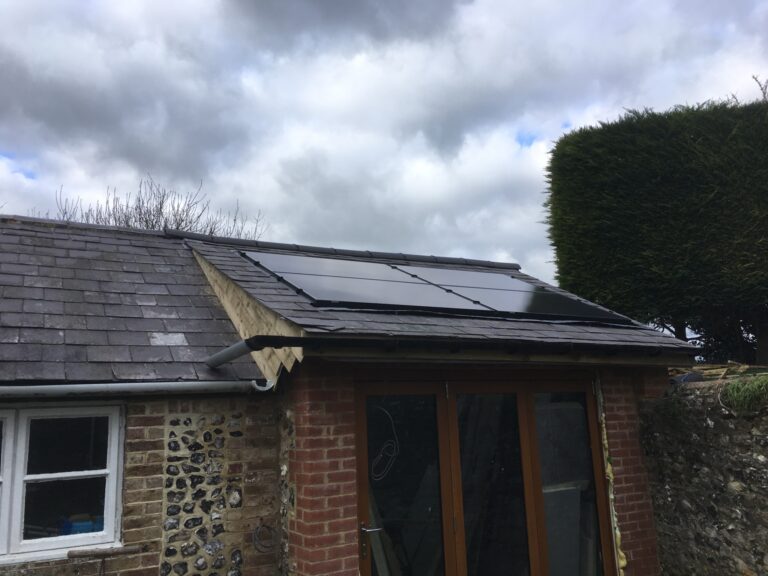
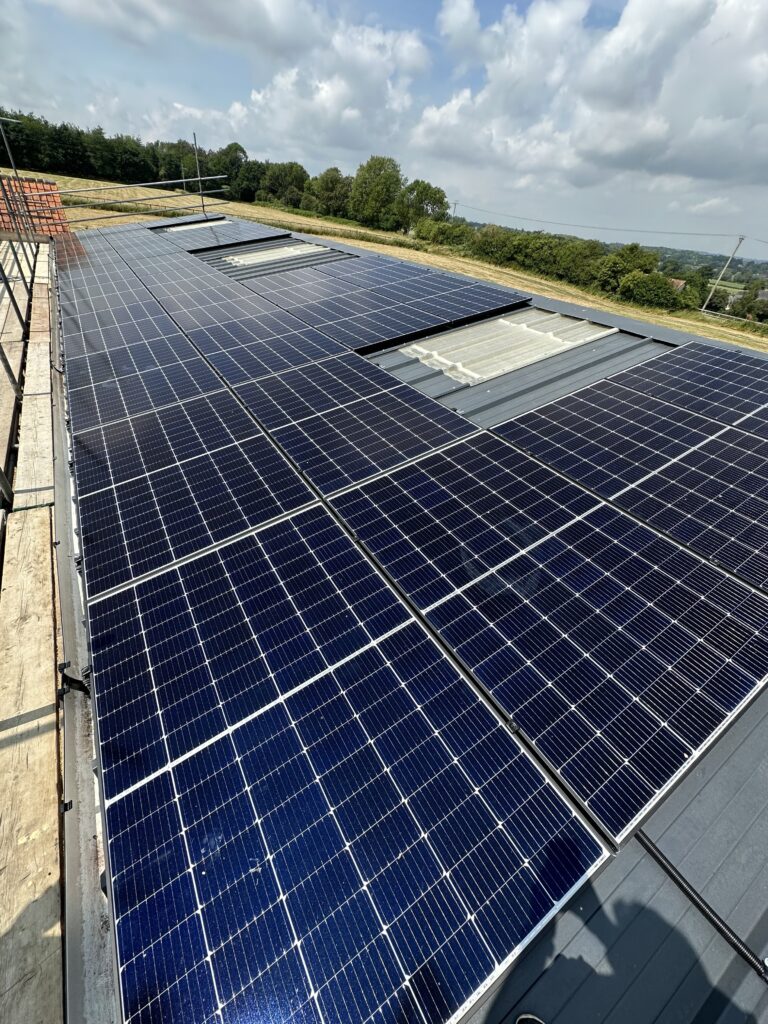
Barns, grain stores, workshops, poultry sheds and livestock buildings can provide substantial areas for PV without taking any land out of agricultural use.
With solar for agricultural buildings, however, the roof itself needs to be considered properly. We look at its construction, condition, orientation, shading and whether it is suitable for the additional loads imposed by a solar array.
If the roofs aren’t suitable – or there simply isn’t enough roof space – ground mounted PV panels can be another option.
A relatively small area of lower-value or awkward land can potentially accommodate a significant solar array. The advantage is that we can generally optimise the orientation and angle rather than working around an existing building.
We are also increasingly asked about farming under solar panels and whether land can retain some agricultural use alongside solar. This is possible in some circumstances, but the design, planning requirements and intended agricultural use all need to be considered from the outset.
Solar panels for dairy farms – and why batteries are changing the calculation
Dairy farms are a particularly interesting application for solar and battery storage.
Traditional milking often creates two significant electrical loads – one early in the morning, before the solar is producing much electricity, and another later in the afternoon.
That means simply matching annual solar generation against annual consumption doesn’t tell the whole story.
The farm might have plenty of solar generation available in the middle of the day, but its morning milking load has already happened.
This is where solar panels for dairy farms combined with battery storage can become particularly effective.
A battery can help bridge that gap. It can store surplus solar for use later or, particularly in winter, charge using cheaper overnight electricity ready for the morning milking.
Milk cooling and refrigeration can also create ongoing electrical demand after milking has finished.
As battery storage prices continue to fall, the ability to move energy from when it is cheap or plentiful to when the farm actually needs it is becoming increasingly valuable.
Battery storage is becoming much more interesting for farms
Battery storage has changed considerably over the last few years. The cost of commercial battery systems has been falling, which means we are now looking seriously at battery storage on projects where the figures might not have stacked up previously.
For farms, the big advantage is being able to store cheap electricity and use it when electricity is expensive.
During the summer, that might mean storing excess solar generation during the middle of the day and using it later for evening milking, refrigeration, ventilation or other loads after solar production has fallen away.
During the winter, the battery doesn’t have to sit there waiting for solar. Where the electricity tariff allows it, it can potentially charge from the grid during cheaper off-peak periods and discharge when electricity prices are higher.
This changes the calculation. We are no longer necessarily looking at a battery that is only there to store surplus solar for a few hours. It can become an energy management tool that is working throughout the year.
Battery storage can also help where a farm has short periods of very high electrical demand. Depending on the site and equipment, a correctly designed system may be able to reduce the amount of expensive peak-rate electricity being imported from the grid.
That doesn’t mean we automatically recommend a battery with every solar installation. If a farm already consumes virtually all of its solar generation directly, the additional saving needs to justify the cost of the battery.
But as storage prices continue to fall, that calculation is changing.
This is why we model the solar, battery and farm consumption together. We want to know what happens across a full year – how much solar is used directly, how much can be stored, when the battery will discharge and whether cheaper overnight electricity can be used to reduce costs further.
For many farms, particularly those with substantial early morning, evening or overnight loads, solar and battery storage together are becoming a much more compelling proposition than they were even a few years ago.
Don’t forget the three-phase supply and the DNO
This is an area where farmers can quickly get bogged down.
Many farms have three-phase electrical supplies, sometimes with several buildings, distribution boards and meters spread across a large site.
Before proposing a large solar installation, we need to understand the incoming electrical supply and what the local Distribution Network Operator – the DNO – will allow to be connected.
The DNO may place a limit on how much electricity can be exported back onto the network.
That doesn’t necessarily stop the project.
An export limitation system can often be used to control the amount being exported while still allowing a larger solar installation to supply the farm’s own loads.
Battery storage can potentially help here too, by capturing energy that might otherwise have been exported, although this needs to be properly designed around the DNO requirements and site consumption.
This is why simply calculating how many panels will fit on a barn isn’t enough.
What does the payback look like?
This is normally the next question.
The answer depends on the cost of the installation, electricity tariff, annual generation and, crucially, how much of that generation the farm can consume itself.
We model those figures before installation so the farmer can see the expected generation, consumption, savings and payback.
Where batteries are being considered, we can also model the potential benefit of storing solar and charging from cheaper electricity tariffs.
There may also be tax advantages to investing in plant and machinery, including available capital allowances, although this is something we always recommend discussing with the farm’s accountant because the treatment will depend on the business and circumstances.
There are also different ways of funding a project.
Some farms purchase the system outright, while solar farm finance can be considered where the business would rather retain its capital.
The important thing is to compare the total cost against the projected electricity savings rather than concentrating only on the monthly payment.
Sustainable energy for farms doesn’t need to be complicated
There is a tendency in our industry to make solar and battery storage sound more complicated than they need to be.
For us, sustainable energy for farms starts with a few straightforward questions.
How much electricity does the farm use? When does it use it? What is it paying per kWh? Is there a cheaper overnight tariff available? What roof or land is available? How much solar can we install? And would storing some of that electricity improve the figures?
Once we have those answers, we can build a sensible model.
Sometimes that means a relatively small system designed to cover a consistent daytime baseload.
On another farm, it might mean several hundred panels across multiple agricultural buildings, export limitation and significant battery storage.
The design should fit the farm – not the other way around.
Cutting agricultural electricity costs for the long term
Solar isn’t going to remove every electricity cost from a farm, and we don’t believe in pretending that it will.
What it can do is allow a farming business to generate a substantial proportion of its own electricity at a predictable cost for many years.
Battery storage adds another dimension.
Instead of simply generating electricity when the sun is shining, farms can increasingly generate when they can, store when it makes sense and buy electricity from the grid when it is cheapest.
With electricity-intensive equipment, large roof areas, three-phase supplies and long-term ownership of the site, the economics can be particularly compelling.
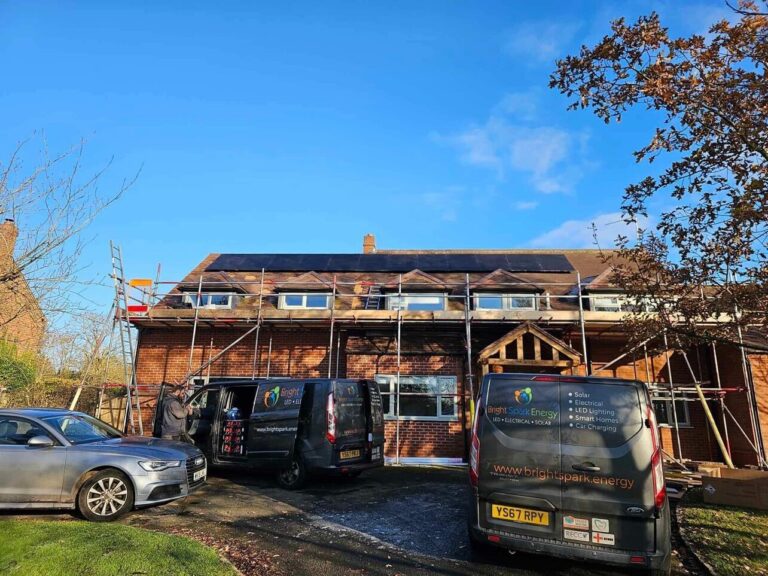
Bright Spark Energy has been designing and installing solar PV systems across Sussex and the South of England for around 15 years. We can look at the farm’s electricity bills and half-hourly consumption data, assess the available roofs or land, check the electrical infrastructure and DNO requirements, and model what a solar and battery installation should actually save.
If you’re looking at your agricultural electricity bill and wondering whether solar on a barn roof, a corner of a field or the addition of battery storage would genuinely stack up, that’s the place to start:
Look at the numbers first, then design the system around them. Get in touch and we’ll take a look at the figures with you.